
My Plant's Looking Rough! An Expert Guide to Diagnosing Common Plant Problems
Help, what's wrong with my plant?
How often do we see that asked? So often, right? But you need to break the question down and get more information before you can really answer it.
First things first: is the whole plant affected or just a few leaves? A new plant owner might panic when they see one leaf yellowing or dying, but sometimes that's just natural for an old leaf to be cast off! Let's get into the main culprits.

The Root Zone (Drainage & Soil)
The biggest problem often starts at the bottom.
- Does the pot have good drainage? Preferably with a hole.
- Is it sitting in a cover pot where water can secretly accumulate? And encouraging the roots to poke through the bottom.
- Is the soil the right mix for this plant's needs? Succulents prefer extra pumice, for example.
- Is it planted in terracotta? These are brilliant for succulents, but not ideal for plants that love to stay damp.
Speaking of soil: when was the last time you repotted it? Having a label with the date is a great way of checking. You'd be surprised—you might think it was only last year, but in fact, it was three years ago!
- Pick up the pot. Is it heavy or super light? If using a plastic pot, is it firm, or are there bulges on the outside?
- Are roots protruding from the bottom, or is the soil surface so packed with roots you can’t even poke a pencil in it?
Position and Light
We know light is everything, but it’s often more complex than just ‘sun’ or ‘shade.’
- What position is the plant sitting in? Is it getting the right amount of sun/light?
- Be careful—too close to a window and the plant can burn. If the leaves are damp, this is even more likely to happen, as light through a window can be harsher than direct sun.
- Is it in a draught, or near an air conditioning unit or another heat source? Temperature stress is a real issue.
- If your plant is a succulent or a cactus, it really should be outside if at all possible. So many plants sold as indoor greenery—like Cacti, Chain of Hearts, and Trandescantia—these are all succulents, which need more light than we give them inside.
I wrote another blog about cacti and their light requirements; read it here.
Watering Habits
This is where most problems begin!
- Does your plant have a dormancy period where you should stop or reduce the water accordingly? (Dormant periods are not always in winter, mind you!)
- Are you watering a teaspoon every day, a cup every second day, or do you pour it on, let it run through, and then do it again? The latter is the right way for most plants.
- Crucially: Do you check if your plant needs watering?
You can often tell just by looking—some plants get floppy, while others you can feel need water. Fleshy succulents can be checked with a gentle squeeze.
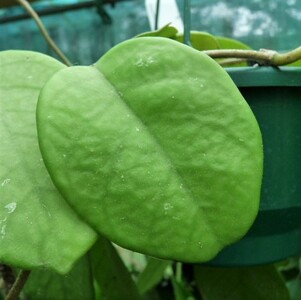
For plants like Hoya, try the flick test on the leaf's edge: very supple leaves mean they need water ASAP, but a firmer leaf means you can wait a bit longer.
 Proof:
This dehydrated Hoya motoskei perked up after it got some water.
Watering should be done on an as-needs basis. Feel the soil deeper down, lift the pot up, and check how heavy it is (before and after watering). If the water seems to be running straight through, the soil may have become hydrophobic. A full repot, breaking up the root ball, is often the only fix.
Dunking into deep water, until bubbles finish popping. Or sitting in a tray with a few centimeters of water and waiting for the plant to soak it up.
I tend to underwater my plants. I can always apply more water if I see the plant hasn't had enough.
But if you overwater, it's so much harder to remove or fix the problem!

Fertiliser
Are you fertilising your plants? If so, how much and how often? Hopefully, with something recommended for your plant! Not all plants appreciate the same type of fertiliser, either.
There's a vast difference between giving your plants some Epsom salts (which is a tonic) and a full spectrum fertiliser (which covers all major mineral deficiencies). A small amount of lime can also often aid yellowing plants.
Insects and Diseases
Check thoroughly for any unusual signs on your plant:
- Colour changes, deformed leaves, weird patterns, holes, lumps, spiderwebs, or sticky residue.
- Can you see any bugs hopping, crawling, or flying about? (Think Mites, Spider Mites, Scale Insects, or the usual suspects like caterpillars, slugs, or snails.)
Insect damage
Mites, spider mites, caterpillars, slugs or snails, scale insects


Without seeing a plant’s conditions, it's hard to tell for certain what is affecting it.
Overall leaf colour changes could mean mineral deficiencies, or it could be from over/underwatering or even insects.
Deformed leaves could be due to a virus or a fungal disease, or just a caterpillar attack!


�� Fighting Fungal Issues & Pesky Insects
A healthy, correctly watered plant is less prone to fungal problems. Good air-flow also helps hugely.
-
Fungal diseases are more common when there is high humidity.
-
Try not to get water on the leaves of plants that are prone to powdery mildew.
If your plant has fungal symptoms, here is a general treatment approach (but remember, don't do it all at once!): a repot, spraying with a fungicide, and applying a balanced fertiliser (but only after you are sure the root zone is healthy).
Alternatively, you can try some home remedies like baking soda, Diatomaceous Earth (D Earth), or isoprop as drying or antibacterial agents.
Treating Insect Infestations
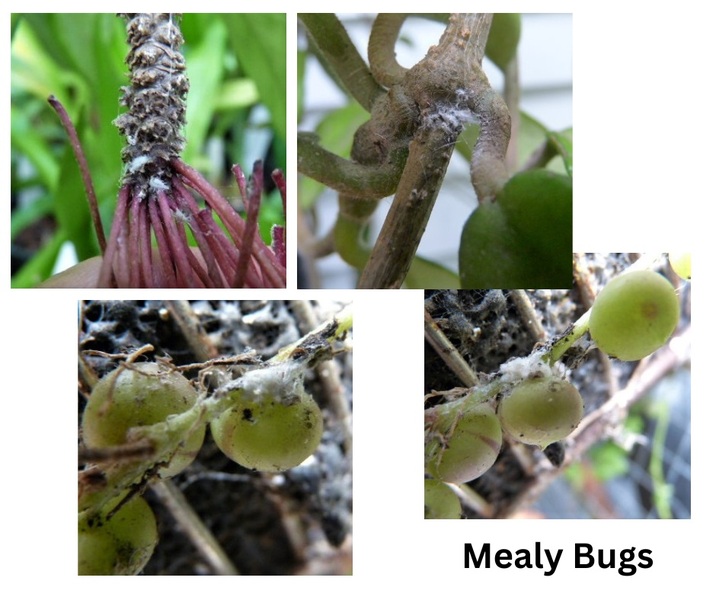
A quick tip on bugs: The white fluff you see on mealy bugs is the adult female. The eggs and the flying males are harder to eliminate. You need to reapply treatments often to get all the life cycles!
Here are some go-to products and applications:
-
Isoprop (Diluted): Can be dabbed onto individual bugs or sprayed. It's also great to add to your pesticide, as it helps break the insect's outer shell.
-
Methylated Spirits (Diluted): Another option that can be dabbed or sprayed on. This is excellent as a sterilising agent on pruners and other tools.
-
Soapy Water: Works well for aphids and can be added to your pesticide spray as a sticking agent.
-
Diatomaceous Earth (D Earth): A fantastic drying agent with multiple uses. Ask me if you would like to add some to an order.
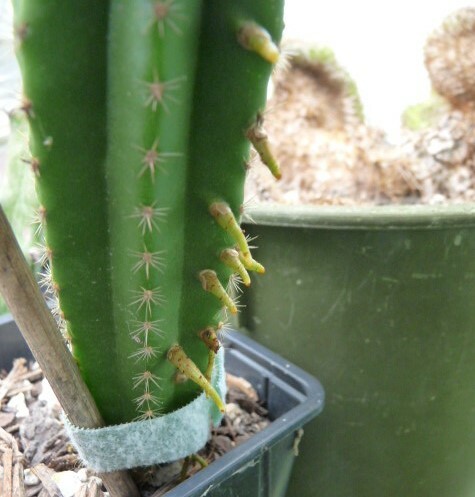
If you've read this far and are still wondering what is wrong with the plant in the cover photo, it's a grafted plant where the top is producing its own roots. This is possibly because the bottom is not sustaining it enough, so it is trying to secure itself and reach more food and water. I should remove that top growth and let it grow on its own roots now, which it will easily do!
Happy to share what I have learnt. I have attended various courses, been trained on-site, and worked in the horticulture industry, so I do have a vast amount of practical knowledge.
Posted: Tuesday 21 March 2023
Recent Posts
Archive
Tags
| Top |