
Etiolation Fix: Why Your Plant is Long and Leggy
�� Stop the Stretch:Why Your Cacti and Succulents Need to See the Light!
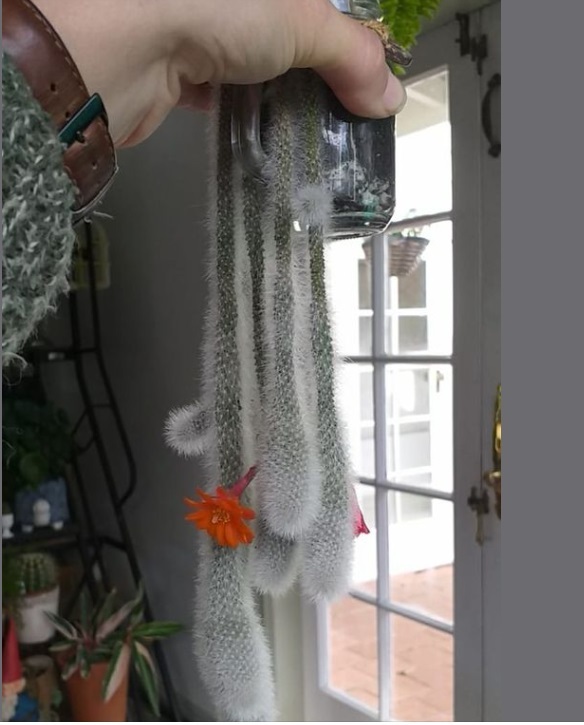
Have a look at this photo. Doesn't it look impressive? You might see this and think, "Wow, what a healthy plant!" It’s really long, covered in flowers, and clearly growing, right? Well, that's what a lot of folks think, but I'm here to tell you that this is actually a cry for help.
When you see a cactus that should be upright and plump suddenly hanging down like a rope, or one that has shrunk and gone pointy on the tips, that’s a sure sign something’s not right. And nine times out of ten, the culprit is light.
Etiolation: The Dreaded Stretch
What you're seeing in these stretched, spindly plants is called etiolation. The plant is frantically growing towards the nearest light source, sacrificing its proper, plump, strong structure to do so.
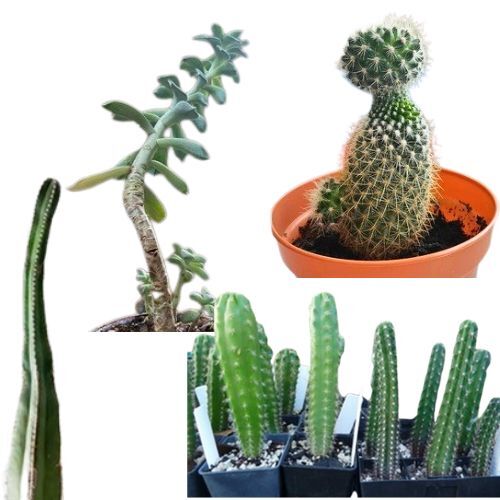
I vividly remember seeing my sister-in-law’s prized collection of cacti on her kitchen bench. These were naturally tall-growing types, like Trichocereus, which should be a good, chunky 10 to 20 cm across. Her plants, though? They were towering, maybe a metre or two tall, but only about 5 cm thin! They were so weak she had to prop them against a wall to stop them toppling over! At the time, I didn’t know what I was looking at, but now I realise they were severely stretched.
The Indoor Trap and the Light Learning Curve
I certainly don't profess to be a plant expert—it's a constant learning curve for everyone! We all start with no knowledge, so please, if you’re unsure, always ask questions! There's no shame in it.
The issue often starts right at the garden centre. Many people purchase succulents and cacti while they're sitting comfortably inside the store, and they naturally presume that's their ideal spot. They take them home and place them inside their house, maybe on a coffee table or a dimly lit shelf.
The plant does grow, and it might even flower. Because it’s growing and flowering, the owner thinks it must be happy.
It’s only when they spot bugs, mildew, or the whole thing starts to collapse that they finally worry and ask, “What is wrong with my plant? ”Before you even worry about pests or disease, the very first thing you need to consider is light, particularly full sun.
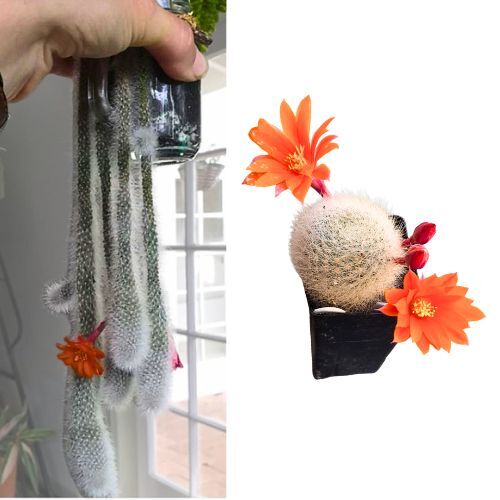
Take the beautiful flowering specimen in Photo 5. The owner was stoked it was flowering and thought it might be a naturally hanging type, perhaps a Monkey's Tail cactus. But then others chimed in, suggesting it was actually a very short, dumpy Rebutia (Photo 7) that was badly stretched looking for light. We've certainly had Rebutia stretch ourselves, so we know how easily it can happen!
The Bright Side: Getting Light Right
The truth is, most succulents and cacti thrive in arid conditions, and do so much better outside. Full sun and great airflow are vital. They go through the seasons and change colour accordingly—that's how you know they're really thriving! If you do keep your desert-dwelling plants inside, they need to be in the absolute brightest spot you have, like a sunny, south-facing window.
People often rotate their indoor plants to prevent them from growing lopsidedly towards the light, which is a good trick, but it can also make it harder to spot the early signs of elongation. It doesn't solve the lack of light problem, it just disguises it. Keep a keen eye out!
The Exceptions to the Rule
Now, before you go chucking all your plants into the scorching sun, remember there are a few happy exceptions:
- Shade Lovers: Succulents like Haworthia and Gasteria happily tolerate, and even prefer, less light. They're great for a bottom shelf getting only indirect light.
- Jungle Cacti: Plants like Rhipsalis, Epiphyllums, and Zygocactus (Christmas/Easter cacti) are epiphytes—they naturally grow in tree canopies in jungle conditions. They need much less direct sun.
Too often, people hear the ‘cactus’ word and assume these jungle dwellers need full sun and almost no water.
You'll often see them looking lovely and red-stemmed, and people think they're doing well.
But they're often struggling and sun-stressed from the harsh conditions.
�� The Wrap-Up and Next Steps
Posted: Thursday 4 August 2022
Recent Posts
Archive
Tags
| Top |